Heaven Can Wait: A Wild Party Review
Sometimes it’s hard to accept that the party is over. The Wild Party, aptly named and still somehow understated, comes to Playhouse on Park’s intimate stage where audiences feel less like accessories and more like accomplices. This musical by Andrew Lippa, guided by the direction of Sean Harris, leaves mouths ajar, some from shock and others, perhaps, with a bit of drool over the seductive Eyes Wide Shut of a theatrical production.
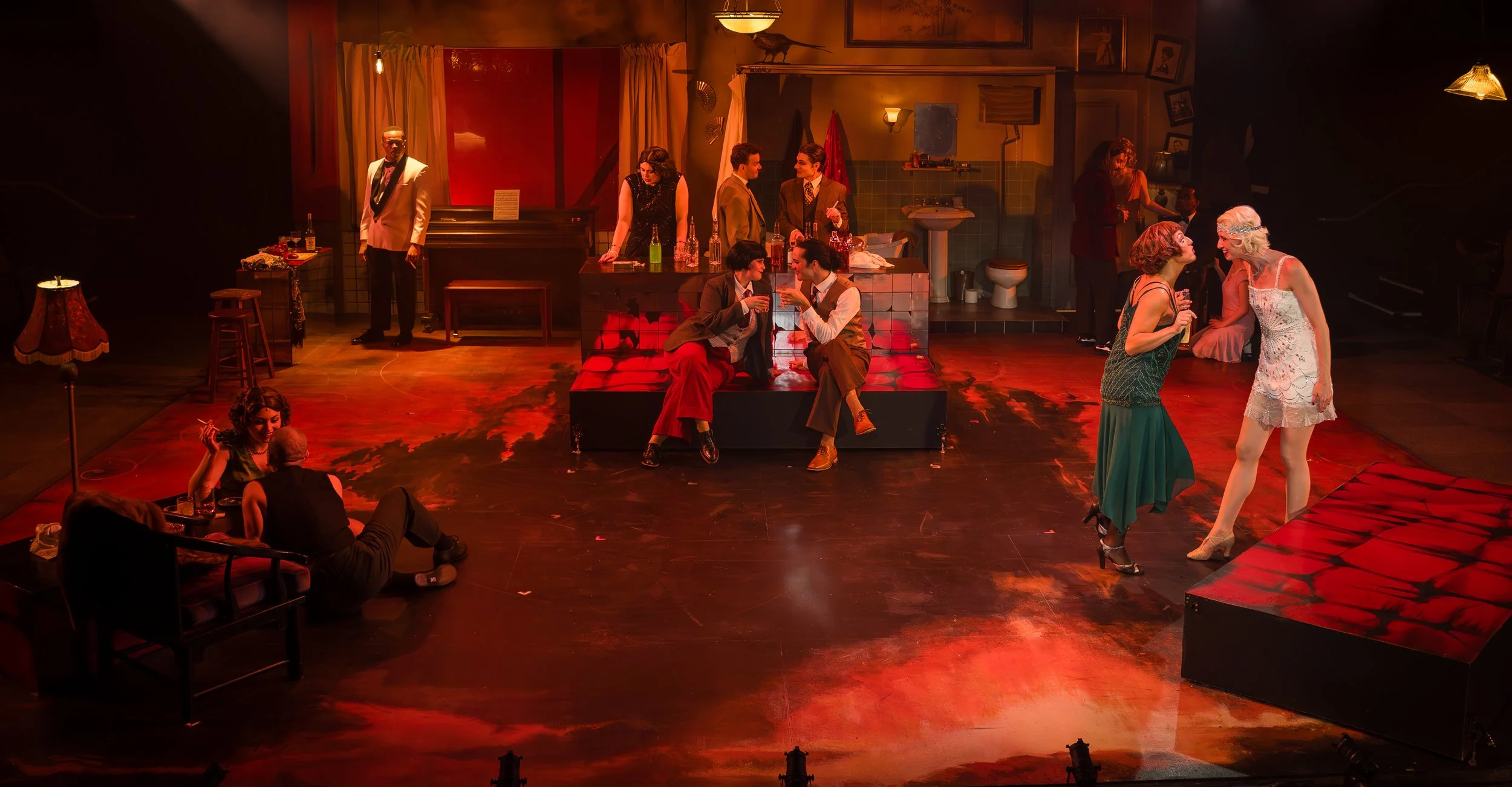
Scene from The Wild Party at Playhouse on Park. Photo by Meredith Longo.
The party, a gathering of friends to balm the soul aches of the leggy blonde with grey eyes, Queenie (Mollie Downes). Queenie’s neuroticism is on full display as she cycles through the glorified self-destructive behaviors of the beautiful and the damned. The men, the drugs, the exterior glamour masking the dilapidated inner life of someone caught between “who am I?” spaces and “who would I become” in time? A fight between riding the high of the hype that others celebrate and the emptiness of a life not reflective of the value of their praise. Enter Burrs (Trevor Bunce), a clown who manages to get Queenie to take him seriously. Theirs is a toxic tryst of codependence in which Burrs’s eyes wander, and Queenie’s inclination toward shows of tit-for-tat jealousy bring bystanders into the fold of their crumpling world. Two such extras in their love story, Kate (Maddi Bowman) and Black (Cory Simmons) find themselves pulled, respectively, to Burrs and Queenie. As Kate’s obsession heightens, her reserve runs dry, and her attempts to lure, seduce, and ultimately steal Burrs’s heart require more substances, fewer inhibitions, and an eventual sinking into emotional madness. Black is taken with Queenie with the most reckless abandon, despite the obvious dangers lurking in an emotionally declining and drugged-up Burrs. This tension comes to a head in a standoff between Black and Burrs with Queenie at the center, and Kate left in obscurity.
The ensemble exhibits a level of poise and grace that depicts what feels like a choreographed fever dream of the contents inside the mind of a psychologically unwell Queenie. The drug-induced stupor of the cast is akin to a choir of spirits, meandering through an already tormented brain space.
Simmon’s voice is grounding, offering a somber balance to numbers like “Poor Child,” where Downes’ higher octave range serrates the cohesion. Bunce is vocally tempered in numbers like “Poor Child” and “Make Me Happy” but breaks loose in “Let Me Drown.” Burrs’s spiral into madness is an emotional offering, cementing Bunce’s contribution to the delights of the production. Downes is a strong performer, with the weight of the production on their voice. The edge of their range is felt as it contrasts the collective timbre of the band in most musical numbers, creating a sonic tension between the overarching vibe of the piece and Queenie’s emotional delivery. This is rounded out with Simmon’s grounding voice, Bunce’s tempered vocals, and Bowman’s velvet-like vibrato.
With show-stealing vocals, Bowman’s Kate, whose character is relegated to the background of Queenie’s show in which she’s overshadowed even in stature, captivates audiences with every note, creating masterpieces of numbers such as “Look at Me Now” and “Life of the Party.”
The elements of this production come together seamlessly, each facet contributing significantly to the unfolding story. Micah Ohno’s costume design beautifully depicts the glamour of the 1920s down to the undergarments. While the scenic design of Kim Zhou and set dressing of Kyla Madore represent not only period accuracy but a breakdown of the difference between Queenie’s put-together exterior and the more shabbily kept interior of her home—matching the breakdown of her story. Darlene Zoller’s choreography layers the storytelling between the tasteful movements of “Jackie’s Last Dance" featuring Joseph Rafael Davila, and the periodic descent into vulgarity as a sign of the times. Matt Weisgable’s lighting design contributes strongly to the dream-like state of the party, from the dim, sultry lights to the hellish and seductive red hues emanating from the window and even the harsh fluorescent light of reality once the long night ends in realization. And as pointed out during a Sunday talkback by an audience member, the audio production between Music director Colin Britt, sound designer Emilee Biles, and additional tech personnel was so phenomenally done that there was not one moment of poor audio quality or feedback despite all of the movement of the cast.
This run of The Wild Party ends on Sunday, August 16th. For tickets, visit https://www.playhouseonpark.org/