New England Man: A Death of a Salesman Review
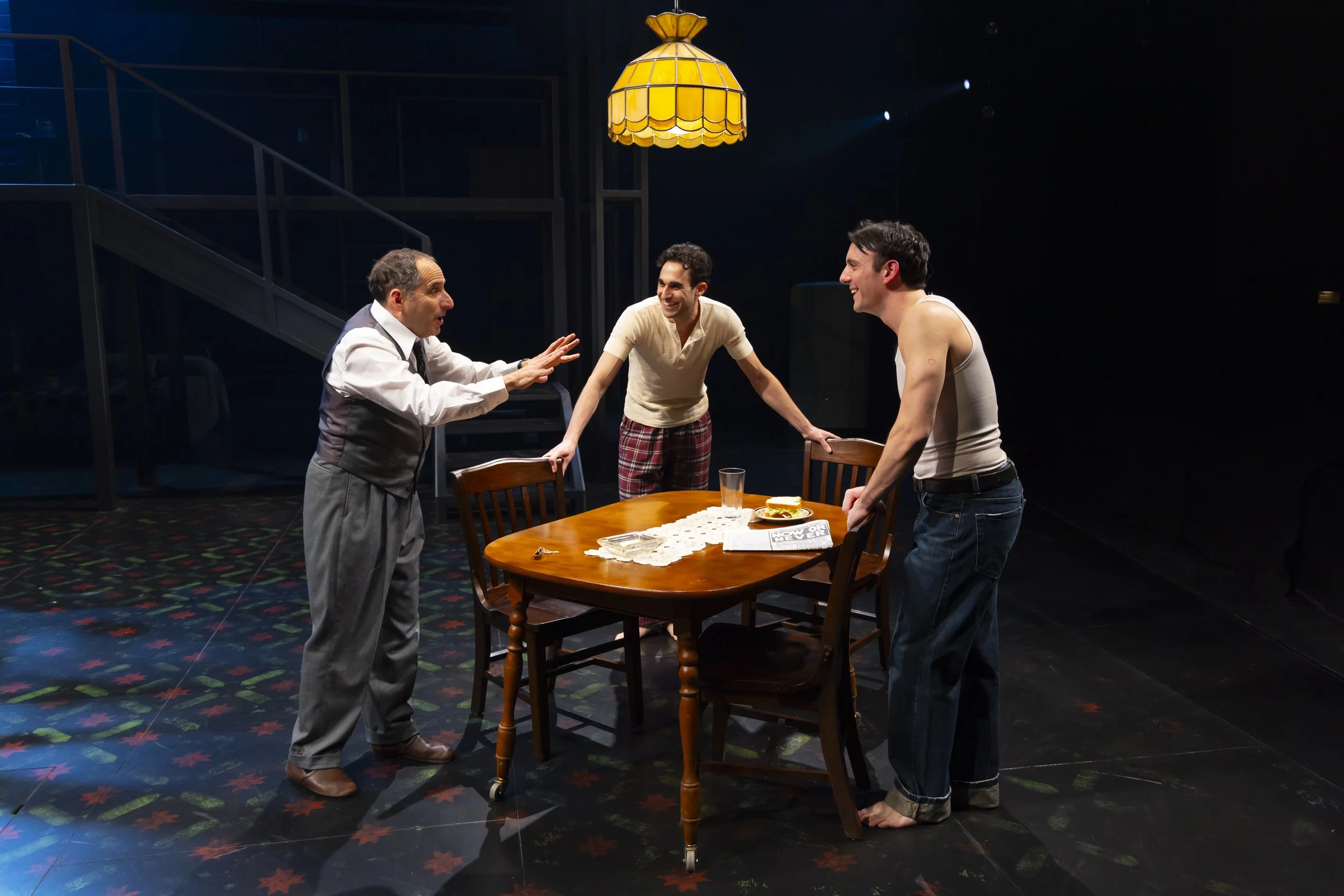
Death of a Salesman HSC 02-26_128: Peter Jacobson, Max Katz, and Samuel H. Levine in Death of a Salesman (2026). Photo by T. Charles Erickson.
Willy and Biff Loman have it out at Hartford Stage in the production of Arthur Miller’s Death of a Salesman, directed by Melia Bensussen—a production that originally graced Broadway in 1949. The classic tale of love, lows, and legacy proves timeless as the struggle for identity, purpose, and value traverses space and time.
Willy Loman (Peter Jacobson), a traveling salesman with his better years behind him, has turned life into a sales pitch—from conversations with his wife to the rearing of his sons, Willy’s life proves to be a performance. His wife, Linda Loman (Adrianne Krstansky), also a performer, pretends not to see through the cracks in the facade. Tensions grow when the lives of his sons, Biff (Samuel H. Levine) and Happy Loman (Max Katz), built on Willy’s sales pitches, begin to rub against the steady decay of his own identity as a well-liked, traveling salesman. Willy’s misguided attempts at raising his sons can be seen in Happy’s wayward, philandering, and Biff’s failed potential. Meanwhile Charley (Paul Michael Valley) and Bernard (Stephen Cefalu, Jr.) serve as a direct contrast to Willy’s life philosophy and the spill-over onto Biff and Happy—Bernard, unpopular and stereotypically nerdy, and Charley, more grounded in the reality of hard work, help to pop the bubble of delusion in Willy’s mind—though the realization arrives much too late.
Krstansky’s Linda is grounded and sobering, managing the delusions of Willy’s words with a balancing pretense that maintains his happiness. Katz’s timing as the utterly unserious, but somehow successful son, Happy, is a thing of beauty. Levine is compelling as he is dragged across Biff’s attempts at solidifying his own identity. Jacobson owns Willy Loman—his characterization of a man driven by a mind converging on past, present, and future stirs a profound level of understanding and empathy for Willy.
The production’s team of designers, from Darron L West’s sound design, Matthew Richards’ lighting design, Harry Nadal’s costume design, and Sara Brown’s scenic design, creates a utilitarian set that serves to bolster the story and keep the focus on the actors.
In celebration of Arthur Miller’s timeless brilliance, in honor of live theatre at a time when it becomes more difficult to tell what’s real, and for the sake of art that still makes us think, feel, and connect—this production is a must-see.
Death of a Salesman runs through March 29th. For tickets, visit hartfordstage.org