The Moor: An Othello Review

Denzel Washington and Jake Gyllenhaal in Othello, at the Barrymore. Photo: Julieta Cervantes
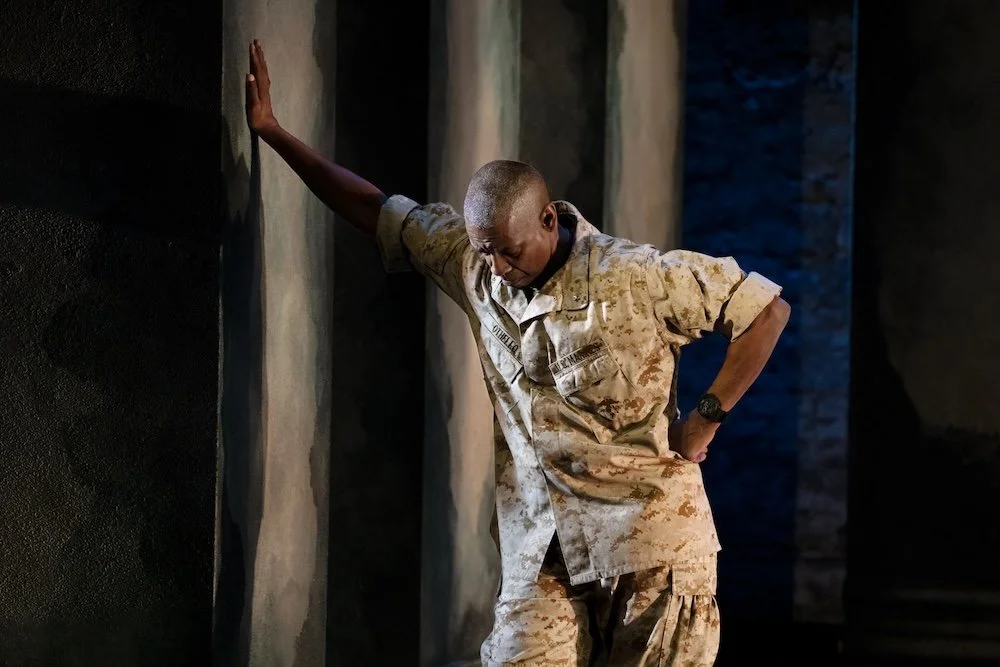
Othello - Denzel Washington. Photo by Julieta Cervantes.
As a girl who grew up learning of the classics in the most impermanent ways, an interest in live theater wasn’t expected of me by anyone, least of all an interest in the densely worded and very particular world of Shakespeare. As I’ve experienced it, there’s an air of pretense and snobbery that lies adjacent to the theatre and even more so as it pertains to anything written by the Bard—so much so that people whose presence is more accepted at the theatre than mine whisper their confusion at the not easily digested language, for fear of looking as pretentious as they feel for saying it any louder. There’s an invisible ‘whites only’ sign and an unspoken “we don’t want you here”—though not expressed or felt by all—that becomes evident in scathing reviews of work that is objectively good.
Anything Shakespeare is a nuisance to be tossed into, off the proverbial street. Going from your conversations with those around you in preparation for the show to being thrust into the dimmed lights and dialogue-rich world of Shakespearean verbiage is an immersive experience in itself. Admittedly, along with the visual adjustment period that dimmed lights require, there’s also an adjustment period for the dialogue where one barely grasps the first 10-15 minutes of a show (unless they are perpetually immersed in Shakespearean theatre or have had the opportunity to study the text in depth prior to the show).
If I can be honest, I would not have gone to see Othello on Broadway had it not been for Denzel Washington portraying the title character. Secondarily, Jake Gyllenhaal has been a delight to watch in film, and his being cast as Iago (after seeing similar duplicity in the Apple TV+ series Presumed Innocent) was an additional selling point. As a film enthusiast and a lover of theater and poetry, it makes sense to experience the crossover of those worlds. Additionally, my proximity to New York and my sister’s equal interest in film and live theatre made the experience all the more memorable. It was the shared experience of the Classical Magnet program (turned school) within the halls of Hartford’s Quirk Middle School that came to life for us, lit by the flames of nostalgia, that sent us flocking to Telecharge, lying in wait for a pair of reasonably priced tickets for a showtime that wouldn’t come for six months.
Given the star status of both Washington and Gyllenhaal, I knew tickets would be steep, but I was curious, so I checked anyway. While there were incredibly rich prices, there were also affordable tickets that I was able to secure in September (2024) for a March 16th (2025) show that didn’t break the bank. What it came down to was a decision to pick the reasonably priced seats in the mezzanine simply to be in the room, or to be salty about the prices of the closer seats and protest with my absence. For me, the latter wasn’t much of an option.
Knowing that my ticket was under $150, it came as a surprise to me when many of the reviews that came out about Othello focused on the higher price points and blamed Washington for the inflated prices. I don’t know what all contributes to the set ticket prices, or whether it was uncommon enough for it to steal the focus of the production and how monumental it had been for fans of Denzel (and even Jake) to share a moment in his illustrious career—to be “in the room where it happens” with someone responsible for so much powerful representation within a community of people who generally don’t feel welcomed in these more elite and creative spaces.
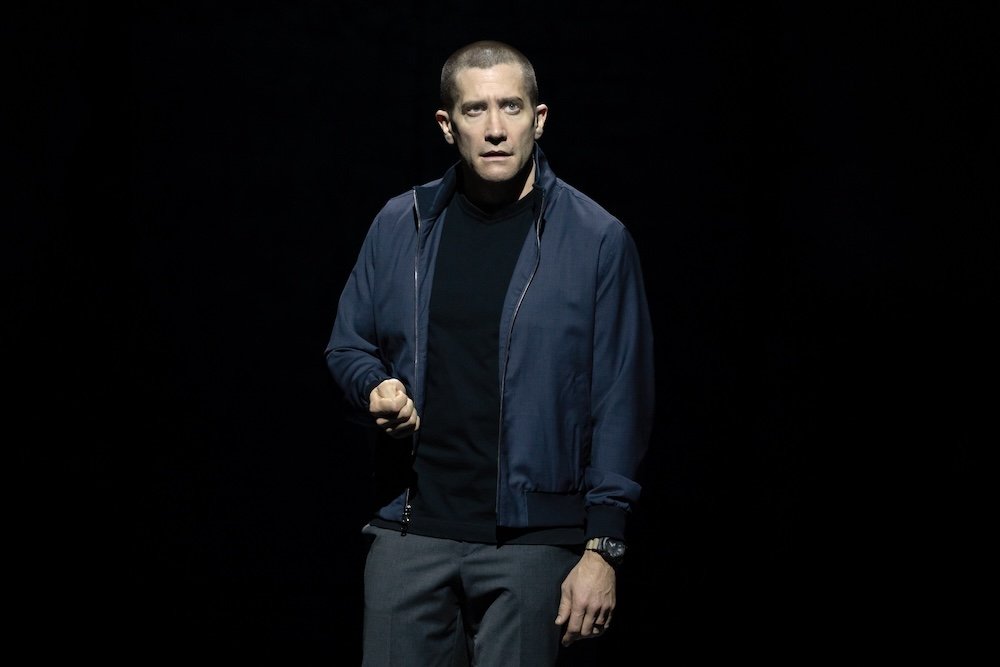
Othello - Jake Gyllenhaal. Photo by Julieta Cervantes.
Despite the surge of pop musicians and film and television actors who have debuted on Broadway in the past year alone (for reasons we can all assume without fear of seeming asinine), this particular production had critics in a tizzy beyond the scope of its quality. So, to add my voice to the rest of the noise, here is my official review of Othello.
Barrymore Theatre’s presentation of Othello brings first-timers from all over to Broadway in anticipation of the live performances of Denzel Washington and Jake Gyllenhaal as Othello and Iago. This production rides on the name recognition of the headlining artists more than that of Shakespeare in a post-COVID climate where live performances and cinema both struggle to fill seats. Washington (with a Tony, two Oscars, and three Golden Globes, among others), whose start in film was preceded by a career in theatre—making his Broadway debut in 1988 in Checkmates as Sylvester Williams and continuing in titles such as Julius Caesar (2005), Fences (2010), and A Raisin in the Sun (2014)— returns to grace a new wave of fans with his thespian chops.
Gyllenhaal (with an Academy Award and a Tony nominee), known for films such as Donny Darko (2001), Jarhead (2005), and Nightcrawler (2014), among others, made his Broadway debut as Roland in Constellations (2015) and followed up with a couple of other productions before landing the role of Iago in Othello (2025).
This production of Othello, directed by Kenny Leon, features a slate, minimalist set design by Derek McLane that lends itself to a military drab, suited for men of war. As the story goes, Othello (Denzel Washington) and Desdemona (Molly Osborne) wed, to the displeasure of Roderigo (Anthony Michael Lopez), whom Iago (Jake Gyllenhaal) was paid to help win over Desdemona. Iago, who reluctantly serves as the ensign to Othello’s position as general, schemes to do away with Othello after he promotes Cassio (Andrew Burnap) to lieutenant over him. Iago’s attempt to draw in Brabantio (Desdemona’s Father; Daniel Pearce) to intervene in Othello and Desdemona’s union fails, so Iago continues to pull strings to ruin Othello with a plot to turn him against himself.
The cast, among a long line of actors and actresses who have taken on the roles of Shakespeare’s characters across productions ranging from school plays to Broadway experiences, contributes a new feel to the story—nothing fundamentally better or worse than before. Neither the actors portraying Roderigo, Cassio, Desdemona, nor Emilia (Kimber Elayne Sprawl) offer any groundbreaking characterizations, yet they play their parts well enough to contribute continuity to the story and nuance to the Shakespearean dialect. The same can be said of Gyllenhaal and Washington—their depictions of Iago and Othello capture the essence of the characters as Shakespeare’s dramatic dynamics dictate, as well as an energy specific to their respective ages, experiences, and understanding of the unfolding plot. As such, the ensemble wins, exemplifying cohesion, a balanced retelling of this vintage tale, and a satisfying experience for those who come with open minds and an interest in what the production has to offer.
The beauty of Shakespeare's timelessness lies in the capacity of his stories to be contextualized for contemporary audiences, whether in set design and wardrobe or in dialect. The capacity of live theatre to experience this revival after the uncertainties of social distancing and mask mandates is a reason to set aside biases and elitism and embrace this new age of theatre, in which we truly are all in this together.
At a time when the arts face new struggles, yet people are finding joy in coming out and getting together to experience the stories we’ve all heard/ read before, in-fighting is a choice.
I’m choosing too, but with love.
—Kimolee